
Counter-Elites
The Battle for America's Soul

We had an establishment Republican elite for a long time with its policies that kind of culminated in the Bushes. We had a Democratic elite with its policies that kind of culminated with Obama. In the last decade, on both sides in the US, there's basically been a revolt within the elites. And this is actually the key point in "The Machiavellians" is the way change happens usually is not the masses activating against the elites directly. What happens is it's the emergence of a new counter elite.
—Marc Andreesen, General partner of Andreessen Horowitz
America is at a crossroads, not just in its political landscape, but in the very fabric of its societal power structures.
At the heart of this transformation lies a growing discontent. The vast majority of Americans feel their elites, those entrusted with steering the nation through economic, technological, and cultural waters, are failing them.
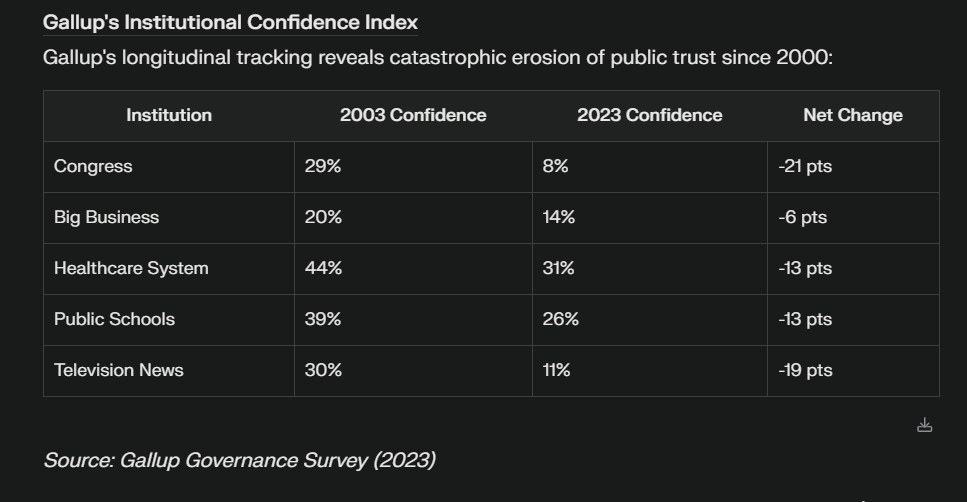
Approval ratings for institutions are plummeting, trust in media and government is at historic lows, and the stench of corruption and incompetence lingers in the air.
From the mishandling of COVID lockdowns, to the perceived overreach and incompetence of the Biden administration, the traditional elite class has been exposed as out of touch and ineffective.
Into this vacuum step the counter-elites challenging the status quo and vying for influence over America's soul.
This struggle is not unique to our time. History reveals a timeless truth about "republican" societies.
They are always ruled by a small, organized elite presiding over a large, disorganized rabble.
When that elite falters, as America's has, a counter-elite emerges to seize the mantle of power.
Elites and the Masses
To understand this moment, we must first grasp a foundational concept articulated in James Burnham’s The Machiavellians: “The Iron Law of Oligarchy”. This principle posits that every functioning society, even those stylized as democracies or republics, is governed by a small, organized elite managing a vast, unorganized mass.
From ancient hunter-gatherer tribes to the Roman Republic, from the British Parliament, to the U.S. Congress, this pattern holds. The masses, too numerous and diffuse to coordinate effectively, cede power to a select few who wield it through institutions, networks, and influence.
In America, a constitutional republic by design, this dynamic has long been evident. The Founding Fathers established a system of checks and balances, but it still relies on elites (senators, judges, corporate titans, media moguls) to govern.
For much of the 20th century, these elites, split between Democratic and Republican factions, maintained a relatively stable equilibrium.
They were the gatekeepers of power, wealth, and prestige. The masses largely acquiesced, trusting that these leaders had their interests at heart.
But trust is fragile. Gallup’s decades-long survey of trust in institutions reveals a stark decline since the late 1960s and early 1970s (Vietnam & the Pentagon Papers), accelerating sharply after 2020.
Today, approval ratings for Congress, mainstream media, universities, and other pillars of elite authority hover in the single digits or low teens.
The masses are restless, and the pitchforks are sharpening.
The Fall of the American Elite
What precipitated this crisis? Two theories emerge.
The first, favored by the elite themselves, suggests the people are wrong, misled by "misinformation" or populist demagogues into a state of "false consciousness."
If only the masses could be re-educated, they’d return to the fold, trusting CNN, Harvard, and the federal government once more. This view dismisses the decline in approval ratings as a glitch to be corrected.
The second theory is more damning: the elites themselves are the problem.
Decades of unchecked power, insulated from competition and scrutiny, have bred corruption, incompetence, and self-interest.
The COVID-19 pandemic crystallized this perception. Lockdowns, enforced with little regard for economic fallout or public consent, exposed bureaucratic overreach and a disconnect between elite mandates and lived realities.
The pandemic response became a focal point for contra-elite mobilization due to the hypocrisy of:
1. Asymmetric Enforcement
California filled their skateparks with sand to “stop the spread”, but allowed massive BLM marches (April 2020)
Nancy Pelosi's hair salon visit during San Francisco lockdowns (August 2020)
Canadian Prime Minister Justin Trudeau's attendance at Freedom Convoy protest (January 2022)
AOC's maskless Miami brunch, after calling for 'draconian' rules in NYC, then fleeing to the freedom of Florida (January 2022)
2. Scientific Establishment Overreach
The CDC's initial dismissal of natural immunity (May 2021) followed by eventual recognition (August 2022) destroyed credibility in non-political experts. Vaccine efficacy claims requiring continuous adjustment ("90% effective" to "prevents severe outcomes") fueled perceptions of elite incompetence.
Dr. Jay Bhattacharya, a Stanford medical professor, faced suppression and censorship on Twitter starting in 2021 when he joined the platform and began sharing views critical of mainstream COVID-19 policies, such as labeling mass testing a "lockdown by stealth."
Internal Twitter documents, later revealed after Elon Musk’s 2022 takeover and detailed in a March 14, 2023, Wall Street Journal article, showed that his account was tagged with a "Trends Blacklist" label, a form of shadow-banning that hid his tweets from trending topics and reduced their visibility.
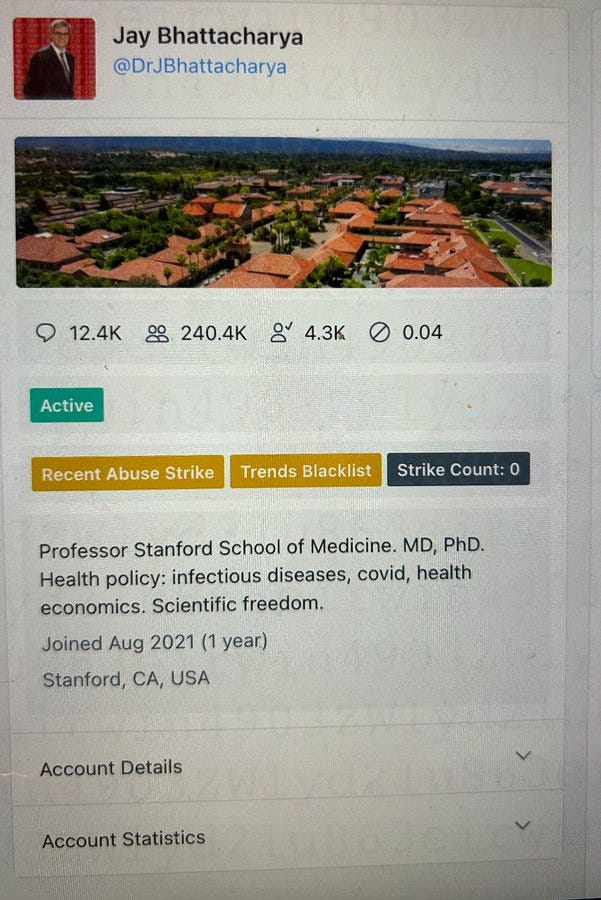
This was confirmed by the "Twitter Files," where journalists like Matt Taibbi reported that his account was flagged shortly after his first tweet, likely due to its contrarian stance, with actions taken by Twitter’s staff possibly influenced by external pressures, including from the Biden administration’s disinformation tracking efforts.
Bhattacharya, unaware of this censorship at the time, later expressed concern that it stifled scientific debate, potentially exacerbating policies like school closures.
3. Financialization of Public Health
Pfizer's $36.8B in 2021 COVID vaccine revenue juxtaposed with FDA's accelerated approval timeline created perceptions of regulatory capture.
Moderna's 4,300% stock price increase (2019-2021) while maintaining government patent protections exemplified elite self-dealing.
The Biden administration, with its aggressive regulatory pushes and perceived coziness with corporate and cultural elites, has only deepened this rift:
Operation Choke Point 2.0: Treasury Department guidance restricting crypto exchanges' banking access
SEC's "Enforcement Sweep" against private companies using Rule 506(c) exemptions
DOJ antitrust action against Medicare Advantage disruptors like Clover Health
From de-banking tech firms to censoring social media, the government has turned on industries once seen as allies, alienating even former supporters like Marc Andreessen, Elon Musk, and Bill Ackman.
This rot isn’t new, it’s been festering since at least the early 2010s, when the "Deal" Andreessen describes from the Clinton-Gore era, collapsed.
Back then, Democrats were pro-business, pro-tech, and supportive of Silicon Valley’s innovations.
By 2013, the party shifted, vilifying wealth (even philanthropy, now smeared as "philanthro-capitalism"), attacking social media after its role in the 2016 election, and embracing radical policies that estranged entrepreneurs like Elon Musk.
The Democratic Party, once a broad coalition, has become the party of the elite. Entrenched, urban, credentialed, and increasingly authoritarian. Meanwhile, the masses, feeling abandoned, have turned elsewhere.
The Circulation of Elites and the Counter-Elite Trap
Burnham’s The Machiavellians offers another key insight called the "circulation of elites."
To stay vibrant and effective, an elite must continually refresh itself by co-opting promising young talent. This serves dual purposes. It injects new energy into the ruling class and neutralizes potential threats by bringing would-be rebels into the fold.
Andreessen recounts his own experience with this process. As a young tech founder from rural Wisconsin, he was courted by the elite.
Invited to Davos, Aspen, and New York Times dinners, the message was clear. Join us, bask in the ego bath, and you’ll be one of us. The price? Conformity. Vote the party line, parrot the approved narratives, and never deviate.
For years, Andreessen played along, as did many of his contemporaries, some of whom are now major Democratic donors. But this co-optation comes with a catch. It stifles dissent.
To remain in the elite, you must uphold the status quo, even when it’s failing. J.D. Vance followed a similar arc, rising from Appalachia to Yale, only to recoil at the elite’s hypocrisy and authoritarianism.
Both men, once potential insiders, became counter-elites, rejecting the invitation to perpetuate a decaying system.
This dynamic explains why the Democratic Party, as the current bastion of elite power, is under siege. Its strategy of absorbing talent has backfired as the system’s flaws, corruption scandals, policy missteps, and a refusal to adapt, became undeniable.
Exhibit A: Nancy Pelosi and the Insider Trading Scandal Complex
Financial disclosures reveal the Speaker Emeritus achieved 45% average annual returns (2019-2023), outperforming the S&P 500 by 32 percentage points. Notable transactions:
$5M investment in NVIDIA call options weeks before CHIPS Act passage (July 2022)
$1.5M Salesforce stock purchase prior to FTC antitrust lawsuit dismissal (September 2023)
While technically legal under the STOCK Act's disclosure requirements, these trades exemplify Machiavelli's maxim that "the appearance of integrity matters more than its reality" in maintaining elite legitimacy.
The Gallup data underscores this maxim: trust in institutions has cratered, with post-2020 drops reflecting widespread disillusionment. The elite’s response, doubling down on control, censorship, and radicalism, has only fueled the rise of a counterforce.
The Rise of the Counter-Elites
Elon Musk, Bill Ackman, Marc Andreessen, J.D. Vance, and others. These are not "men of the people" in the populist sense. Most are wealthy, educated, and influential.
But they position themselves as champions of the masses against a failing elite. Musk, once a Democratic darling, now rails against government overreach and backs Trump.
Ackman, a financier, has broken ranks to critique woke capitalism and elite hypocrisy.
Andreessen, a tech titan, advocates for American dynamism and open competition, clashing with regulators and closed-source AI labs.
Vance, previously a VC, senator, and now VP, embodies the counter-elite ascent, leveraging his outsider narrative to challenge the establishment.
This group isn’t a monolith, but they share a common thread. They’ve rejected the elite’s script.
They thrive not by blending into the Davos crowd, but by amplifying the frustrations of the disorganized rabble, whether through X posts, policy critiques, or entrepreneurial gambles.
Their rise aligns with Burnham’s model. Change rarely comes from the masses directly but from a new elite displacing the old.
Trump’s 2016 victory over Jeb Bush, powered by rural voters, exemplifies this. A counter-elite triumph over the Republican establishment.
Globally, this pattern repeats. In the UK, Nigel Farage’s Reform Party and Jeremy Corbyn’s Labour insurgency threaten the Tories and Blairites.
In Germany, the AfD’s rise signals a counter-elite bid on the right.
Everywhere, incumbents, governments, media, universities, face anti-incumbency waves, their approval ratings in freefall.
The masses aren’t revolting with pitchforks. They’re voting, consuming, and aligning with new voices that promise to upend the old guard.
Technology and the Counter-Elite Advantage
Technology amplifies this shift.
The Deepseek R1 Chinese LLM, freely available and runnable on modest hardware, undercuts proprietary U.S. labs like OpenAI and Anthropic, slashing costs by 30x and democratizing access.
This "Sputnik moment" inverts expectations. American elites hoard AI behind closed doors, while a supposed rival delivers abundance.
For counter-elites like Andreessen, who champion maximum competition and openness, this is a boon. It weakens the grip of centralized power and empowers outsiders, from startups to individuals.
AI’s reasoning capabilities, now exploding with models like DeepSeek’s R1 and Perplexity’s R1 1776, promise to reshape capital allocation and innovation for years to come.
The counter-elites thrive here, betting on disruption over conformity, as seen in their push for American dynamism in defense tech, energy, and biotech. Fields the old elite neglected.
The Soul of America
This battle, elite versus counter-elite, isn’t just about power. It’s about America’s soul.
The elite, tied to the Democratic Party and its urban, credentialed base, cling to control through regulation, censorship, and institutional inertia.
Their failures, COVID mismanagement, economic hollowing, and cultural disconnect, have eroded their legitimacy.
The counter-elites, leveraging technology, markets, and populist rhetoric, offer a vision of renewal. Openness, innovation, and strength without authoritarianism.
Andreessen’s hope is for America to win this "Cold War 2.0" with China not through war, but by doubling down on its values: freedom, open markets, and competition.
The counter-elites aim to seduce the world by providing a shining city on a hill. Much like the U.S. outlasted the Soviet Union in Cold War 1.0.
Yet, the outcome hinges on whether they can displace a rotten elite without succumbing to the same traps of power.
For now, the fight is on. Approval ratings, corruption scandals, and Gallup’s trust metrics signal a nation fed up with its ruling class.
The counter-elites, tech moguls, renegade politicians, and cultural disruptors, are ascendant, promising to restore what’s been lost. Whether they succeed will determine not just who governs, but what America becomes.
Only time will tell, you write. And the early signs? I'm a bit shocked at how insulated the counter elite has already become. The sharp criticism of the left-leaning elite has turned into rationalizing away everything being said and done by the current admin. Even if you love the general drift, blanket endorsements are a clear tell. The capacity for self-criticism sees to be a trait that few elites possess. The radical transparency we all should support? I see obfuscation and compulsive lying. The recent All-In interviews with Bessent and Luttnick are great examples. It's about access, not independent thinking. It's echo chamber sychopancy.
Exactly right. Elites rarely switch places with other groups… they split instead, and struggle amongst each other over values and privileges.
https://jmpolemic.substack.com/p/the-schism-of-the-elites